Showing posts with label Articles. Show all posts

Monday, January 31, 2011

February is Pet Dental Month

There are several ways you can care for your pet’s teeth every day. A complete home dental care program for your pet often will include brushing as well as a pet food or supplement that helps care for your pet’s teeth while he or she eats.

Even if you aren’t able to brush your pet’s teeth every day, by incorporating a pet food into your pet’s daily routine or supplement, you can provide the dental care needed to keep your pet healthy. Be sure to talk with your veterinarian about the options that exist and which are right for your pet.
Brushing Your Pet´s Teeth

STEP 1: Introduce a brushing program to pets gradually. Avoid over-restraining your pet and keep brushing sessions short and positive. A cat or small dog can be held in your lap. Praise and reassure your pet throughout the process.

STEP 2: At first, dip a finger into beef bouillon for dogs or tuna water for cats. Rub the soaked finger gently over the pet’s mouth and teeth. Make the initial sessions short and positive.

STEP 3: Gradually, introduce gauze over the finger and gently scrub the teeth in a circular motion.

STEP 4: Finally, you can introduce a soft toothbrush designed for pets. Use a sensitive or ultra-soft brush designed for people or a brush designed for pets. Special pet toothbrushes are available from your veterinarian or specialty pet store. Don’t use toothpaste designed for people because it could upset the animal’s stomach.

Check out this video on how to introduce your pet to daily brushing and teeth care from the American Veterinary Medical Association:

Does your pet already have heathly, clean teeth?  Then you can upload pictures of your pet’s healthy smile to http://www.flickr.com/groups/pearlywhitepets/! Show us their smile!

Sunday, October 31, 2010

Make an older dog's life easier with these tips

Your dog may breeze through years of senior citizenship without any significant health issues, but sooner or later, age catches up with even the most resilient of canine companions.

You may one day discover that your dog can’t see or hear anymore, or that he’s developed an irritable streak where he didn’t have one before. In many cases, the first really distressing issue to come up is incontinence — an old dog may dribble urine in his bed or in the house — and suddenly you have a problem.

Any time a new health issue develops, the best course of action is to have it checked out by your dog’s veterinarian. And there’s this good news: Many problems are treatable at any age, including cognitive dysfunction — doggy dementia — which can be eased for many dogs with medication.
Time, of course, will not be denied. But even for those things that cannot be aided by your veterinarian, you can take matters into your own hands and help your dog age gracefully and comfortably.
Remember, this is an animal who adores you, who lives for your approval and affection. As he begins to lose his health, he needs your assurance more than ever.
Some special situations you may deal with:
  • Blind dogs: Maintain your blind dog’s environment with minimal change. Dogs actually adapt amazingly well when they lose their eyesight — as long as you don’t start rearranging the furniture. If your dog knows his way around your house and yard and has a walking route that suits him, try to keep these things constant to prevent injuries and put him at ease.
  • Deaf dogs: For a dog who lives in a soundless world, sudden contact can be unnerving. It can also be dangerous for the person who delivers the shock, since your dog may nip out of fear. Learn how to let your dog know you’re coming, and teach any children who have contact how to do so, too. Many dogs are hearing-impaired but not completely deaf, and for those a couple of simple hand claps are enough to get his attention. If your dog is completely deaf, step loudly as you approach him — your footfalls will cause a vibration that can be felt even if it’s not heard.
  • Leaky dogs: If your dog has overnight incontinence, know that the situation probably upsets him even more than it upsets you. Take him out last thing before bedtime, and then provide a water-absorbent barrier in his bedding. You can use a puppy pad, cut-up pieces of a water-resistant mattress pad, or an upside-down, rubber-backed bath mat. Whatever you use will need to be washed or replaced daily, but the extra loads of laundry are a small price to pay to ensure your senior dog is comfortable.
Once again, be sure to work with your veterinarian on the challenges of age. Be especially keen on the combinations of prescription pain medications and so-called “neutraceuticals” — over-the-counter supplements like glucosamine and omega-3 oils — that can make life comfortable.
Slow down, be patient, be helpful. You’ll both feel better for the time you spend with your sweet older dog.
All information copyright 2010 by Dr. Marty Becker and Gina Spadafori. This information is provided for the personal use of Pet Connection readers and may not be reproduced in any way or in any media without expressed, written permission of Dr. Marty Becker, Gina Spadafori, Honest Dog L.L.C. and the Universal Press Syndicate.

Wednesday, October 27, 2010

Tips for Surviving the Scariest Night of the Year


The spookiest night of the year is almost upon us. For kids and many adults, its a howling good time, but for many dogs... not so much. Superstar behaviourist and MD blogger Colleen Safford shares tips for a happy—& safe—Halloween.

Issue 1: Costumes. I know. I know. How do you NOT dress the Dachshund up as a hotdog? It's just too easy. But, as a trainer, I've seen moms and dads with bitten hands because, well, it wasn't so easy after all. Err on the side of caution. Halloween is supposed to be fun after all, and if your dog is stressed or miserable in his or her costume, well then, it's not so much fun! If you opt to select a costume, be sure it's safe. Some pups like to nibble, and loose parts that dangle or those that can be swallowed are hazardous to your dog. Make sure your dog can still wear his appropriate leash/collar and IDENTIFICATION when wearing his or her costume.

Solution: If your dog is less enthused about dressing up, a cute bandanna or festive collar (or wig?!) is perfect.

Issue 2: Candy. It's well known that chocolate and dogs do not mix. If your dog consumes chocolate, call your vet immediately. He or she will likely want to know the amount consumed and will advise you on the appropriate course of action. Sparkly, crackly oh-so-fun to play with candy wrappers can also pose a threat when consumed. Lastly, Xylitol, a sweetener used in some candies, is poisonous to our four legged family members.

Solution: To avoid treats from becoming tricks, always place all candy up high on shelves or in closed cabinets. If possible, avoid having Xylitol and chocolate in your home on this night when you are going to be a bit distracted.


Issue 3: Revolving door of trick or treaters. Halloween is not without a lot of hustle and bustle. Knocking at the door, a ringing doorbell, an opening and closing door, and a constant stream of strangers arriving to your home—dressed up, no less, and screaming "trick or treat!"—are all just part of the festive evening. If your dog is reactive to strangers coming to your home, or the sounds of the door, he may feel overwhelmed by all of the commotion. The opening and closing door also poses a flight risk for nervous dogs or those who simply lack impulse control and want to race out and join in the fun.

Solution: Keep your pooch safely enclosed behind a closed door or crated during trick-or-treat hours. Give your dog an activity to pass the time, like a food stuffed toy (Kong, Molecuball, Tricky Treat Ball). At the minimum, if your dog is not crated, be sure your dog is wearing a collar with identification, in case he or she gets out the door! If your dog is extremely reactive, stressed, and fearful, honestly, your best course of action is to turn off your lights, stick a bowl of apples on the porch (Ha! Who wants apples!?) and skip the festivities. Your priority is your pooch. He or she will be oh so grateful to not get such a fright on this chaotic night.


For more from Colleen, like "Puppy Parenting Reality Check - Peeing, Pooping and Chewing... Oh MY!" to "No Pulling! Tips for Teaching Your Dog to Walk Nicely on Leash," check out Colleen's blog, Secrets to a Good Dog.

Monday, July 5, 2010

Too Hot for Spot: Save Dogs this Summer

From the PETA website:

Be a Dog Defender: Save Dogs This Summer!

Summer is a season for celebrations—the Fourth of July, beach trips, picnics in the park, and barbecues! However, it can be a very dangerous time for dogs. Every year, countless dogs die after overheating inside parked cars. We need you to be a dog defender by looking out for dogs who are locked in hot cars. You can be the difference between life and death for dogs this summer.

Prevent Heatstroke by TakingThese Precautions:Never leave a dog in a parked car.
On a mild 73ºF day, the temperature inside a car can reach 120ºF in 30 minutes.
On a 90ºF day, the interior of a vehicle can reach 160ºF in minutes.

If you see a dog in a car and in distress, take down the car’s color, model, make, and
license-plate number, have the owner paged inside nearby stores, and call local
humane authorities or police. Have someone keep an eye on the dog. If police are
unresponsive or too slow and the dog’s life appears to be in imminent danger,
find a witness (or several) who will back your assessment, take steps to remove
the suffering animal, and then wait for authorities to arrive. Contact PETA for
a supply of fliers on the dangers of heatstroke to leave on windshields.

Don’t carry your dog in the bed of a pickup truck. This is always dangerous, but the heat brings the added danger of burning the dog’s feet on the hot metal.
Don’t take your dog jogging—except on cool mornings or evenings—and don’t force exercise. On long walks, rest often and take plenty of water. Hot pavement can burn dogs’ paws; choose shady, grassy routes.

Trim heavy-coated dogs’ fur, but leave an inch for protection against insects and
sunburn. Keep an eye on areas where hair is thin, like eyelids, ears, and nose
as they can get sunburned. Keep your dog indoors. If he or she must stay
outside for long, avoid the hottest part of the day. Provide shade, water, and a
kiddie pool. Keep drinking water in an anchored bucket or a heavy bowl that
won’t tip over.

Be a watchdog for chained dogs. Make sure that they have food, water, and shelter. If you see a dog in distress, contact humane authorities. Give the dog immediate relief by providing water.

With summer right around the corner, remind people about the dangers of leaving unattended animals inside hot vehicles. Thank you for taking action to save dogs during these dog days!

Tuesday, March 30, 2010

What is separation anxiety and how to treat it?

Find how to treat your pets anxiety at the Pawhaus Pet Boutique.

Vets and trainers are often consulted about dogs, who when left alone, cry, howl, bark, urinate, defecate, or simply destroy everything in their paths. Whatever destructive or inappropriate behavior your dog engages in when you leave him alone, he is not doing it to “punish” you for leaving him alone. Rather, his behavior is generally the result of stress, fear and/or boredom.

Depending on your dog’s behavior when you are gone you can sometimes differentiate between stress-related behavior and boredom. For example, assuming you are giving your dog appropriate opportunities to relieve himself during the day, urinating and defecating in your absence is more likely to be a sign of stress than of housetraining problems. If upon returning home, your dog is panting and sticks to your side like glue, it is likely he is suffering from separation anxiety.

Many dog behavior experts sub-divide separation anxiety into “true” separation anxiety and “isolation distress.” With “true” separation anxiety your dog’s fears are focused on a particular person (“Oh no! Jane’s gone!”). With isolation distress, simply being alone is the problem for your dog. Thus, isolation distress can sometimes be alleviated by the company of other dogs or people – letting your dog stay with a friend when you are out or taking your dog to doggy daycare. Separation anxiety can be more challenging to address because your dog’s stress is triggered by being away from a particular person. To learn several things you can do lessen your dog’s separation anxiety, click here.

Thursday, June 18, 2009

Summer survival tips for a happier, heathier pup and environment!

via Raise a Green Dog! by Johann The Dog on 6/9/09


Summer is finally here, and dog am I happy! I love summer, all the fresh air, fun times outside in nature, swimming, hiking, agility, picnics, and lots more.

But there are lots of dangers out there for us pups during the dog days of summer. So we wanted to put together our top 10 green dog living survival tips, to help you have the healthiest, safest and most environmentally responsible summer ever!

Here we go....

Tip #1

Us dogs we spend a lot of time in our yards, it's an extension of our home! So be sure and keep those lawns super safe and free of harmful chemicals. Those pesticides, insecticides and herbicides are super dangerous for us dogs (and humans too). So go organic and feel free to safely enjoy your lawn and help the environment too!

Tip #2

Heat can be a killer. So take lots of precautions when having fun with activities outside. Make sure there's plenty of filtered fresh clean water available at all times. Wear some pup boots if you're pounding the pavement, it can be super hot on sensitive paw pads. Keep your pup cool with an eco-friendly cool coat and lots of shade. Cool down your pup with cool water on the paw pads and on their tummy. Not too cold though, it can be too much of a shock. And very importantly, learn the signs of heat stroke and the location of the nearest emergency vet hospital, just in case.

Tip #3

Summer is traveling time! So be sure and practice all the important safety measures when traveling, like buckling up your pup in the car, taking lots of extra filtered water from home and transporting that water in a leach proof container. And stock up on healthy organic foods for your trips. Take along those biodegradable bags to pick up the doo and help the environment. Add a first aid kit and emergency contact info to your car or vehicle. And make sure your pup is wearing their tags at all times.

Also, help us share with other folks about the dangers of leaving pups in cars, because they can heat up like ovens and become killers!

Tip #4

Contrary to pupular belief, not all dogs know how to swim coming out of the womb. We need to learn how to become confident and be safe in the water. So teach your dog to swim for safety's sake. And check out an float coat (that's what we use when we go canoing!)

Tip #5

Get your exercise in the early morning or later in the evening when it's cooler. Taking those long walks or hikes, and other activities during the cooler parts of the day will be much more fun.

Tip #6

Watch out for dangers when you're out and about. You know those puddles, retention ponds, river and streams could very well be laced with lots of lawn and farming chemicals, so try to find safer alternative places to swim, like a fun kiddie pool in the backyard, or a nice chemical free swimming pool, supervised of course! Gracie and I absolutely love our kiddie pool on a hot day!

Tip #7

Fleas and ticks love the summer weather just as much as we do. So what's a dog to do? Take healthier and safer precautions in preventing and deterring these nasty bugs. The EPA and the Natural Resource Defense Council has provided us with warnings of the dangers of many over the counter flea and tick medications. So get educated, there are safer alternatives.

Tip #8

Summer is a time to celebrate and a time for super cell storms. All that celebrating humans do can be very stressful for us pups. Loud noises, large crowds and fireworks can sometimes be way too much for some pups. And that nasty thunder and lightening can scare a pup half to death! So try and minimize these stressful situations, and look into a pheramone or homeopathic remedy that may help relieve your pup from some of the suffering of summer bangs.

Tip #9

On super hot days (like we have here in August and late July) we plan time to have fun indoors! We have fun learning new tricks. It works our brains and tires us out just as much as a long walk would. So when it's super hot, take the time to learn something new and have fun at the same time.

Then have your Mum, whip up a nice cool Homemade Frosty treat all your hard work!

Tip #10

Get out there and have fun! Enjoy your summer, the healthy way for you and the environment!


Thursday, April 23, 2009

Why Soy?

The Pawhaus Pet Boutique carries a wonderful line of soy based candles that, no only smell great, but are also better for you than a standard paraffin candle. Here is why:

CLEAN BURNING -- Soy wax is non-toxic and burns cleaner than paraffin, with no petrol-carbon soot which can blacken walls, ceilings, and furniture, contaminate ventilation ductwork in your home, as well as add toxic carcinogens into the air you breathe.

LONG BURNING -- Soy candles burn slower and cooler than paraffin wax, creating a longer burning candle.

RENEWABLE RESOURCE -- Soybeans are a renewable source, unlike paraffin, which consists of petroleum.

BIODEGRADABLE -- Since soybeans are vegetables, soy wax (basically made from hydrogenated soybean oil) is naturally biodegradable. Soy wax is also easier to remove from materials and other surfaces than paraffin wax.

HELPS THE FARMERS -- Buying soybean products creates important economic growth for the agricultural sector of the US economy.

Soy candles are simply better for you, your family, and your environment.

Paraffin Wax
There are three main reasons many people avoid buying petroleum (paraffin) products:

  • Petroleum smoke/exhaust contains many carcinogenic toxins and produces ugly black soot
  • Petroleum is not a renewable resource and it is of a limited supply
  • Burning petroleum products creates air pollution and contributes to global warming

Paraffin candles contain up to 11 carcinogenic compounds. These 11 compounds have been deemed 'toxic air contaminants' by the State of California. An air quality researcher, David Krause, has documented evidence that candle soot particles contain many of the same compounds given off from burning diesel fuel. In the Nov/Dec 2000 edition of the Emagazine, in an article titled, 'The Inside Scoop,' Kathleen O'Neil writes that a recent study of residents in both residential and an industrial areas found chemical levels in the subjects' bodies indicating they had received doses of pollutants in their homes five to 70 times higher than the highest outdoor levels. Burning candles are listed in the article as contributing their share of indoor pollution.

Health hazards are being created when paraffin (petroleum-based wax) is mixed with synthetic fragrance (some not even meant for combustion), and are compounded with chemical fixatives, synthetic glosses and bleached cotton wicks. Health problems have been more evident in the past five or so years due to the increase in popularity of highly scented candles. Hundreds of thousands of dollars of home and furniture damage have been reported, causing a battle with insurance companies and retailers of the candles.

Unfortunately, a large percentage of the human population is not aware of candle ingredients, although awareness is growing. One reason is that candle ingredients are not required to be listed, and labels are often worded in such a way that some consumers think they are buying healthy, aromatherapy candles, when in reality the candle is mostly a petroleum wax, synthetic scent, synthetic fixatives, with a little bit of plant essential oil added in. Even if a candle is labeled as being made of beeswax, often there is paraffin as well. The wicks are usually made of chemically grown cotton that has been bleached using dioxins. Wicks that have a metal, or zinc core, contain small amounts of lead.

Most department stores provide no other option than to buy paraffin candles. However, some natural food stores have began carrying plant-wax candles.

So, if you want to try one of our Soy candles - check out what great scents we carry HERE!

Tuesday, March 31, 2009

Something Silly at the Pawhaus

Just in time for Spring! The Pawhaus Pet Boutique is proud to introduce Silly Little Sock Bunnies Dog Toys. Exclusive to our shop and we LOVE that these adorable bunnies are made right here in Canada!


We thought it would be great to talk a little about who the local artist is who makes are awesome little Silly products and here is what she had to say:


Silly Little Sock Monkeys and Friends are the products of an artistic mom and her beloved, creative side-kick, a four year old with a wonderful adoration for stuffies (and puppies too!).


It all began one day when we came across a pattern for making a sock monkey. It was the perfect companion for my daughter, no batteries to replace, no worries about recalls and with those gangly arms, legs and tails- it could swing as high as her imagination! In no time, we began taking orders from friends and strangers alike that would stop us at the park and ask, where did you get that cute little sock monkey?”.


Just before last Christmas, fate had its way and The Silly Little Sock Monkeys (and Friends) ended up at a table beside The Pawhaus at a community show and sale. I will admit to be a little surprised when Amanda asked if I’d ever thought about making sock monkeys for dogs! After watching my daughter’s fascination with the squeaky toys on display at The Pawhaus , I quickly realized that children and dogs are much alike in their toy preferences!


So began Silly Little Sock Monkeys are Friends for Dogs, our product line exclusively for our canine friends available only through The Pawhaus.


Each of our Silly Little Sock Monkeys and new Silly Little Sock Bunnies are made with all new materials and TLC. Hidden inside, a squeaker will delight your dogs with a cause and effect experience (gnaw and it squeals!) and rest assured that each squeaker has been quality control tested by my vigilant 4 year old little girl.


When you purchase a Silly Little Sock Monkey or Bunny you are buying local-supporting a Calgary art-doll artist and offering your dog really cool toy to play with!
Enjoy!


Holly and Abby McWilliams
Silly Little Sock Monkey and Friends Artist

You can find more of Holly and Abby's creations on her own website at http://www.members.shaw.ca/sillylittlesockmonkey/

Saturday, March 21, 2009

How Often Should I Wash my Dog?

Most advice you find on the internet recommends washing your dog just several times per year!Either these people have outdoor dogs or the articles were written a long time ago when the quality of pet shampoos was very poor! Times have changed!

Today, dog’s enjoy shampoos and conditioners that are on par with the best human shampoos- that don’t have harsh chemicals and that don’t strip the hair of all of it’s oils.The arguments against washing your dog too often are generally about stripping the coat of natural oils. The more often you wash something, the more often the sebum (oil) is going to be removed.

Think about your own hair. If you don’t wash it, what happens? It gets oily. Is the oil good for your hair? Probably, but we wash our hair everyday anyway so that it’s clean!

There are several factors you should consider when deciding how often to wash your dog which include:
  1. Does your dog live indoors or outdoors, and does your dog sleep in your bed?
    If your dog lives in your house with you and more importantly, if he/she sleeps in your bed, then you are probably going to wash your dog regularly–depending on the breed anywhere from once a week to once a month. I know this is radical thinking, but, if your dog sits on your sofa, you probably don’t want him dragging in dirt, poop, insects and other grime onto your sofa. So, the trade off is that your dog’s coat ~might ~ be marginally drier but you will have a fresh smelling dog that you can cuddle without the fear that gross stuff is getting into the sheets.
  2. Breed of dog.
    Dogs that have dry skin can be bathed less frequently than dogs with oily skin. Harsh-textured coats repel dirt pretty well so they don’t get as dirty as a soft-coated dog. Dogs like Maltese, Yorkies, Afghans and Shitzus should be bathed once a week. Harsh-coated breeds, like Shelties and Collies, can be bathed once a month. If you’re not sure, remember, a clean dog is a happy dog! One of my dog’s is a Maltese and I can’t imagine washing her less than once every week. Little white dogs pick up lots of dirt and by weeks end they are looking brown instead of white. Also, I hate to mention it but long-coated dogs get those famous cling on poops stuck to their bottoms.My other dog, a Westie, who has a thicker coat, doesn’t lget so dirty, but, I have to wash her every week due to the next point– allergies.
  3. Is anyone in your household allergic to dogs?
    If so, you SHOULD groom & bathe them as often as possible. According to the American Lung Association, doing so will help remove the dander that accumulates on a pet’s fur.I am allergic to one of my dogs and when I don’t wash her once a week I get wheezy and sneezy.
  4. What activities does your dog partake in?
    Do you take your dog to the dog park? Does you dog play in the sand or dirt? Does your dog roll in the grass or go swimming or hiking? What about sniffing butts, eating poop or drooling?Well, if you have a normal dog, she probably partakes in several of the above activities– all of which warrant regular bathing. Again, you have to think of the trade off. Your dog’s coat may be marginally drier. HOWEVER, he will be cleaner, smell better, and most important you will be more likely to give a clean dog lots of love. Those smelly dogs we tend to keep at arms length.
  5. Does your dog suffer from itchy skin?
    Unlike humans who absorb most environmental allergens through their noses and mouths, dogs tend to absorb allergens through the skin. Weekly bathing can prevent itchiness , washing allergens away before they get a chance to penetrate the skin.

So at the conclusion of all of this — the answer for MOST dogs is to wash them once every week to once a month, depending on the above circumstances.But remember, use a gentle pet shampoo and conditioner . Do not use your own shampoo.

Click here for an article of why you should not use your own shampoo on your dog. Also, if you simply can’t wash your dog for a prolonged period of time you can use a dry shampoo, like Dry Dog Instant Clean - This is a really effective spray on bath replacement that helps to get rid of bad odors.

Friday, March 20, 2009

Gnawing Problems

Is your dog chewing you out of house and home?

Dogs tend to chew or gnaw on inappropriate objects when they're bored, anxious, or craving attention. Designating play zones throughout your house and equipping each with a few pup-friendly chew toys and treats can cut down on the destruction. If you catch your dog in the midst of destructive chewing, take the item from him or her and walk away. On the other hand, if your dog is happily chomping on a toy, stick, or bone, reinforce the good behavior with enthusiastic praise and petting.


Source: DogAge.com

Wednesday, March 18, 2009

Dog Exercise Needs

Source: http://dogtime.com/exercise-needs.html

We often think of exercise only as a health issue, but it has significant day-to-day effects on a dog's behavior as well. Dogs--particularly puppies and young dogs--have a lot of energy, and if they don't get the chance to burn it off, destructive behavior is often the result. If you're annoyed at the holes your dog has dug, have headaches from his barking, and have to replace pillows shredded into expensive fluff, your dog's probably not getting enough exercise.

These behavior issues cause many people to give up their dogs, even though they're completely preventable. (You know those "free to a good home, dog needs room to run" ads? They're usually placed by people whose dogs don't need room to run; they need exercise they're not getting.) Unfortunately, some people don't think enough about exercise when selecting a breed, and they choose a dog who needs more exercise than they're willing or have time to provide.

How much exercise does my dog need?

How much exercise is enough depends on your dog's age, breed, and health. A 10-month old Irish Terrier puppy is going to need more than a five-year old Whippet (you could appropriately sing, "Wild thing, you make my heart sing" as your puppy races around the house and yard). A sight hound needs short bursts of exercise; guarding dogs don't need as much overall as sporting breeds who like to hunt all day. Even within a breed, the need varies. A highly energetic eight-year-old Golden Retriever could easily need more exercise than a calm three-year old Golden. And geriatric dogs still need to go for walks--just shorter ones than they used to enjoy.
Generally speaking, a leashed walk around the block isn't going to cut it. Most dogs need 30 to 60 minutes of exercise a day. Your canine pal needs enough that he's slowed down by the time you stop.

Some general rules of thumb:
  • Active breeds need a minimum of 30 minutes of hard aerobic exercise most days of the week, preferably daily.
  • Not all toy or small breeds get enough exercise inside the house (contrary to popular belief). Pugs, for example, are prone to obesity and need much more exercise than they usually get.
  • It's not safe to go out in extremely hot or cold weather. During such periods, stay inside and teach tricks to engage your dog's mind, throw toys, or run up and down the stairs together.
  • Good exercise uses both mental and physical muscles. Exploring a new hiking trail, for example, engages your dog's mind as well as his body.
  • Live by the philosophy that a tired dog is a good dog.

Where to get exercise

Like people, most dogs like both familiarity and a little variety in their exercise routines.
Many dogs get to know the neighborhood during walks and enjoy checking on their favorite spots.

Dog parks are popular places for off-leash exercise and romping with other dogs, which is exactly what most dogs need. However, not all dogs can play nicely with others. If your dog doesn't like other dogs, the dog park is definitely not the place for him.

Doggie day care can exercise both his mind and body. Dogs should come home from day care worn out and deliciously happy.

The cost of not getting enough

Inactive dogs are often overweight dogs, and as in people, that brings plenty of health risks. Obesity contributes to a dog's risk of diabetes, respiratory disease, and heart disease. It exacerbates common orthopedic concerns such as hip dysplasia and arthritis. Obesity can stress joints, ligaments, and tendons. Geriatric dogs often have a hard enough time getting up without the added problem of lifting excess pounds.

Tuesday, March 17, 2009

Quick Tip Before Buckling Up

Whether your furry friend rides in a belt harness or a car seat while on road trips, I wanted to point out a quick tip for safety. Even if you prefer collars for walking, don't clip these to a seat belt or car seat attachment.

Personally, I don't believe in traveling with an unsecured pet period and, under no circumstances, should you drive around with a restraining device attached to your dog's collar. (I don't need to give you the graphic visual, but I'm sure you can picture what happens if you slam on the brakes.) Next time you're ready to hit the road, stock a harness just in case or, invest in a special version that attaches straight to the car safety device from your walk time, too!

Source: PetSugar

***PRODUCT BUZZ*** Check out the great products we carry to keep your pup safe, secure and CLEAN in the car!***

Sunday, March 15, 2009

Add Your Pets to Your Will

Have you ever thought about what would happen to your pets if you were no longer around to take care of them. Yes, I know this is a sad thought, but unfortunately it is a very real concern for many people, as their pets are family. An increasing number of pet owners are including their pets in their wills to provide for them long-term. I have experienced this in practice a few times, where dogs come in with a ‘caretaker’ and are treated according to the guidelines of a will or their trust.

Surprisingly this is not a new concept as pet trusts were recognized by English common law back in 1842. The legal system has changed a bit since then, so it is important to keep a few things in mind when planning for your pet's future needs in your absence.

  1. Identify a Caretaker for your pet that you think loves your pet almost as much as you do. Discuss your wishes for your pet with this person, as well as your lawyer. Set aside funds to be used according to your wishes that will be supported by state or local law.
  2. Carry an Animal Card in your wallet. This will alert medical personnel that you have a pet at home that will need care in the even that you are unable to tell them yourself. This card should have your pets name, breed, color and your veterinarians contact information on it.
  3. Discuss with you estate attorney the yearly budget for your pet, as well as its standard of care; for example: How often it should be fed and what brands of food. How often your pet should be walked, how many physical exams it should get per year. How often it should be groomed. Living conditions (indoors/outdoors). And lastly what should be done with any excess funds in the event that your pet passes prior to using all the money you left for its care.


Source: WagReflex --Dr. Hamilton---------------------Dr. Hamilton is an oncology resident at Michigan State's Animal Cancer Care Clinic and a regular contributor to Wag Reflex.
Disclaimer Regarding Veterinary Information

Friday, March 13, 2009

The Dirt on Goughnuts

Written by: Lynette at the Fun Times Guide


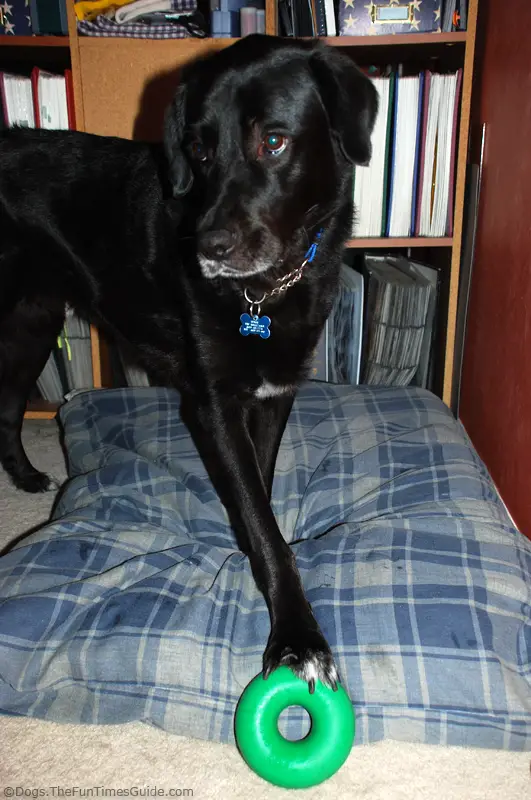
We recently introduced the GoughNuts dog toy to our dog, Tenor, for the first time.
Think: A 'doughnut' that dogs go nuts for.
Let me just tell you... the minute that package arrived in the mail, somehow he instinctively knew it was for him. I don't know if it was the strong smell of the rubber that was wreaking from the package itself, or what. But he kept pestering me until I took the time to open it and let him see what it was.
And he immediately loved it!

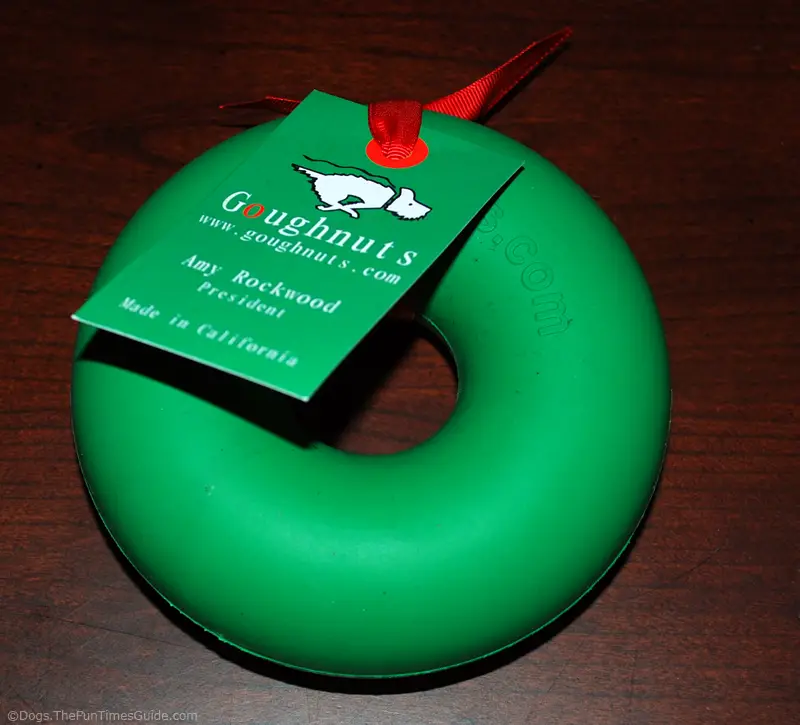
What Makes GoughNuts Unique?What makes this dog toy so different is the fact that it's made from nearly indestructible rubber. I'd say it's even tougher than Kong toys. (I know, I was surprised by that, too.)
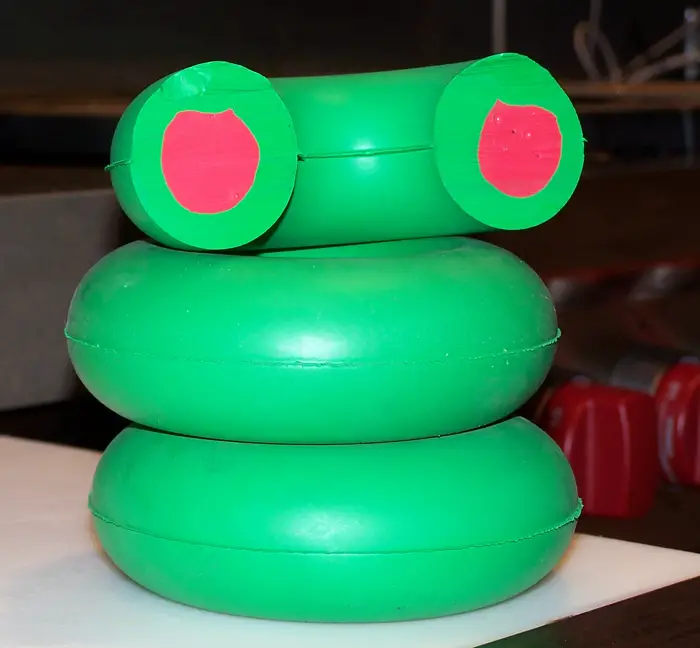
It's got an outer layer of one grade of rubber that is green, and an inner layer of a different grade of rubber that is red. The built-in secret to this toy is... if your dog should ever manage to chew so much on this toy that he gets to the red inner rubber ring, then it's time to throw the toy away and request a FREE replacement from GoughNuts.

The purpose of the "Chew Toy Safety Indicator" is to change pet chew toy technology for dogs and other pets so that the possibility of blockages (from ingestion of chew toys) in a pet's digestive track will be lessened or eliminated. "The Chew Toy Safety Indicator" is a mechanism for pet owners (primarily dog owners) to visually see a color change in the chew toy indicating that the toy design has been compromised. The universally known colors of "green for go" and "red for stop" are utilized in this inventive design. Source

For the life of me, I can't imagine how a dog could ever do that. But I guess there might be some super power chewers out there that could.

Virtually Indestructible - Many companies claim it, GoughNuts guarantees it. Every GoughNuts toy has been designed by Mechanical and Polymer Engineers. Understanding leverages that are present in the jaws of a dogs mouth and relying on 60 years of rubber technology has resulted in an indestructible toy. If your pet can chew through the Green to expose the Red, GoughNuts will replace your toy free of charge. Source

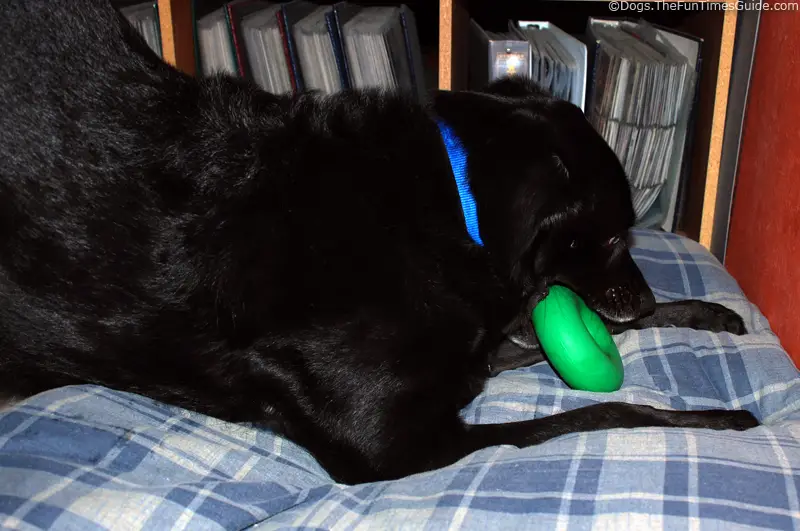
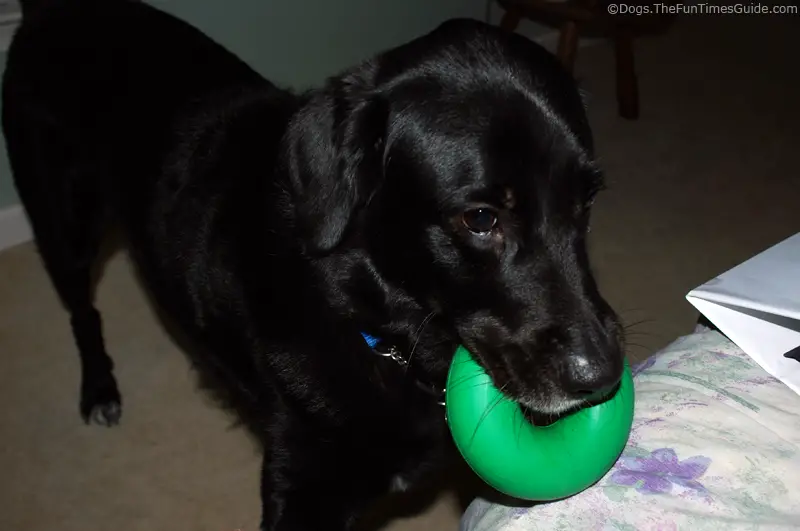
What Is The GoughNuts Dog Toy Like? The GoughNuts toy itself is a very thick very bouncy rubber ring. It is similar in shape to the Kong Air Dog Donut toy. But the GoughNuts toy is much thicker, much squishier, and a tad smaller in overall diameter -- so it's easier for a large dog to put his whole mouth around it, yet it's still big enough to prevent him from choking on it.
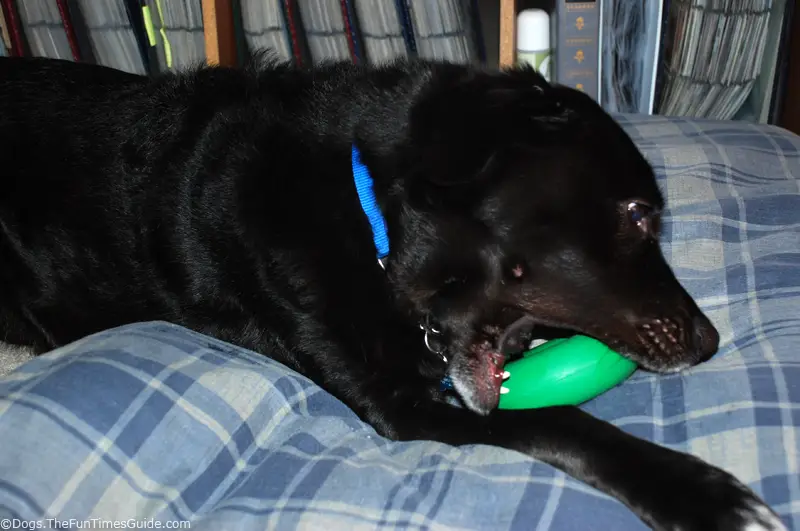
For the record, my dog likes to bite and chew (hard) on dog toys. But chewing for the sake of chewing is really not his main priority. Instead, he gets most of his enjoyment from dog toys by rolling them around on the floor, getting them to make noises, trying to pull things out of them, and occasionally trying to destroy them. (GoughNuts is definitely one dog toy that will never break or wear our in our household. I'm sure of it.)

So, if my dog is not exactly a power chewer, then why does he like the GoughNuts toy so much? For these reasons:

It is extremely bouncy! Sometimes he kicks the GoughNuts toy around with his own paw and then chases after it in a self-fulfilling cat-and-mouse game. Sometimes I'll just roll it on its side down the hallway, and that's enough to entice him to play... hard! It's as if he's been reminded of how much he likes this toy, at which point he starts playing with it like it's the first time he's ever seen it. And it's always fun to just toss the GoughNuts on the floor from about waist-high and watch as the dog waits to see where it lands. At which point, he runs full-speed for it and starts playing with it for a long time.

It makes a squeaky noise. No, there's no squeaker in this dog toy. It's more of a built-in squeaker! You see, whenever the dog's slobber gets on the rubber ring, and his teeth start squishing the rubber, you get this soft squeak that my dog loves. It's as if the toy is challenging him... or talking back to him.

The size is just perfect. I really like that it's a thick and chunky toy, yet there's a hole in the middle that is large enough to make it easy for the dog to grip. That's one important characteristic of a good dog toy in my book: the dog must be able to grip it and grab it and walk around with it and manipulate it in some way. Otherwise, it's a boring playtime experience. The GoughNuts dog toy is sized just right that he can get most of his mouth around it, but not completely.

It's relatively lightweight. I got the large size for power chewers. (I have a 90 lb. Black Lab/Great Pyrenees mix.) And one of my pet peeves is when large dog toys are so heavy and bulky... so much so that the dog tires easily from playing with them. I mean, my dog likes to grip a dog toy within his jaws, then give it a toss and see where it lands. The GoughNuts chew toy is perfect for this. And because it's so bouncy, you never know where it will land. And because of it's shape (a round ring), you never know where it will roll to.

They're made in the U.S.A. with your dog's safety in mind. California, to be exact. You've gotta love that!

Plus, dog safety is their #1 concern. ("Our goal is chew toy safety.") Yep, that's why they invented the patent-pending "chew toy safety indicator" in the first place. GoughNuts are the first dog chew toys that this safety mechanism has ever been implemented in.

Overall, the GoughNuts dog toy is definitely an fun toy for dogs. It's never the same play session twice. My dog really likes this one!

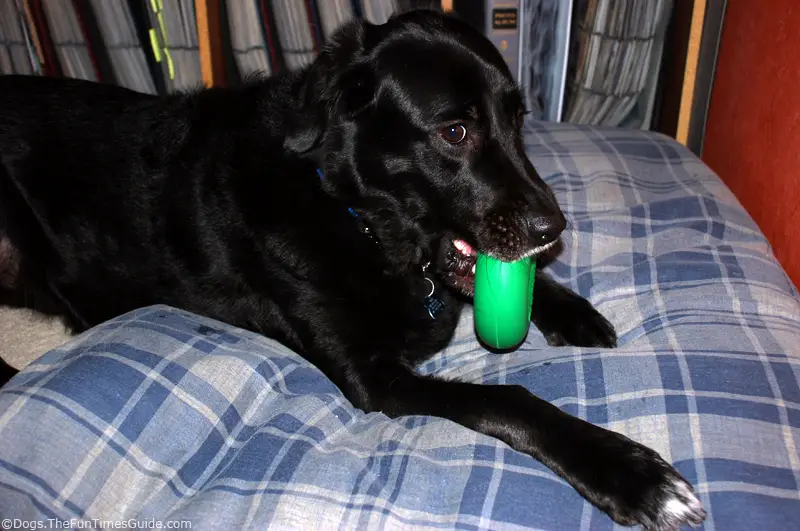
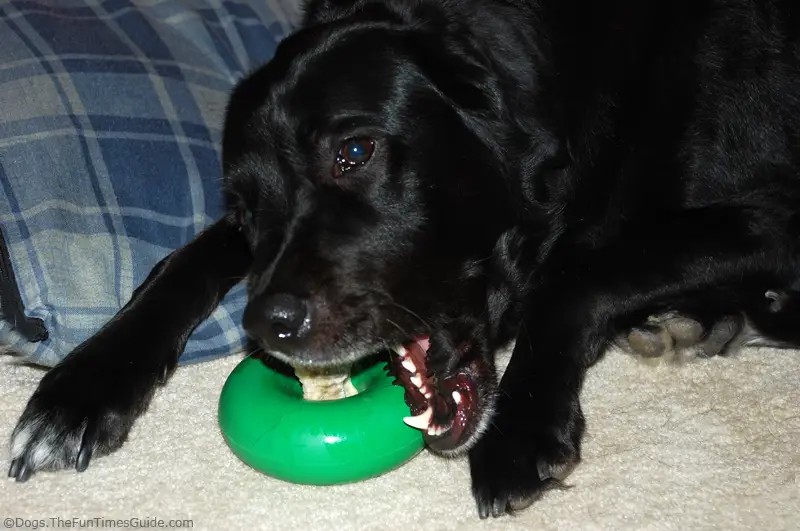
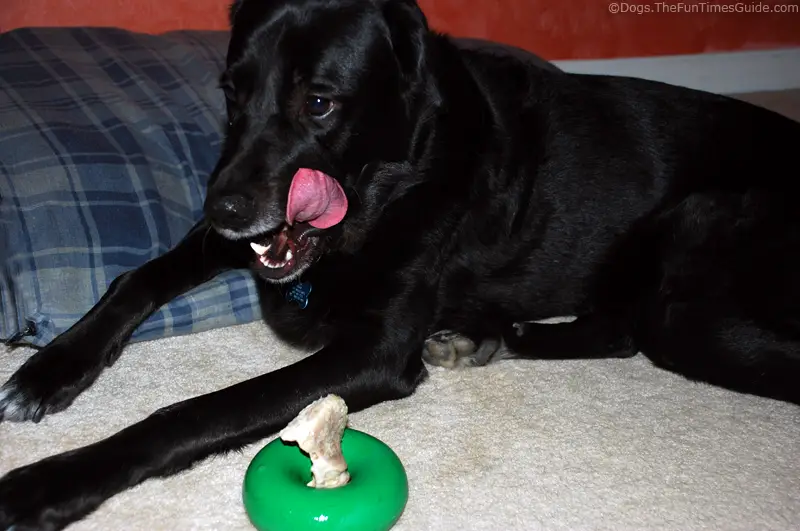
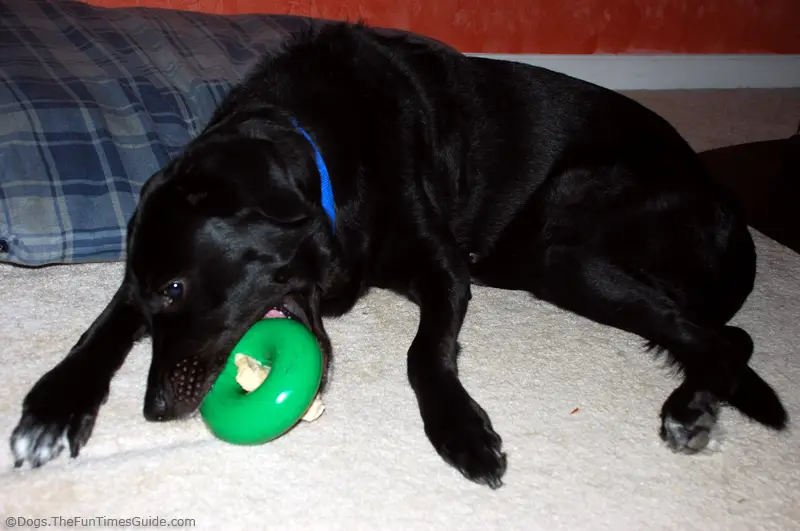
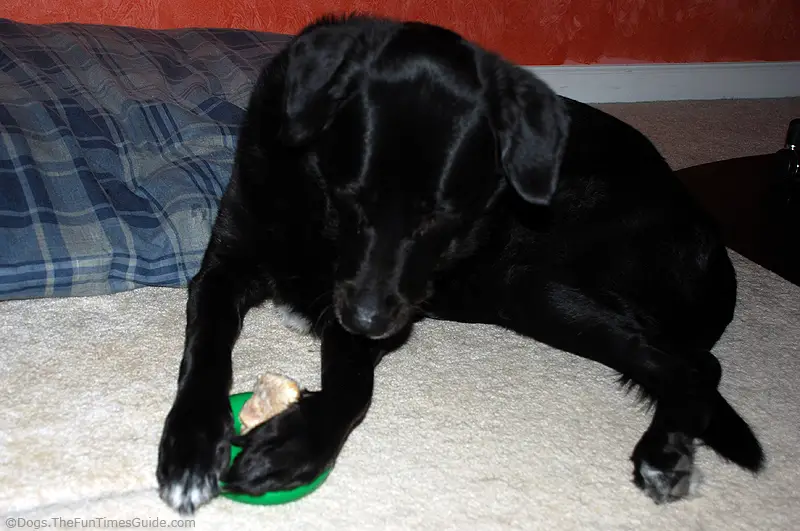
You can "stuff" it with fun goodies. And finally, stepping a bit outside of the box here... I thought I'd try to "stuff" something inside the hole that's cut out of the center of the GoughNuts toy. I grabbed an old dog bone and crammed it in there, realizing that if my dog's teeth weren't going to damage the GoughNuts toy, then the sharp edges on this raw bone weren't going to hurt it either.

This really got my dog's attention! He worked on it for a long time trying to get the bone out of the center of the GoughNuts chew toy. That makes GoughNuts the equivalent of 2 toys in one. You could stuff it with another fun dog toy (maybe one that rattles or squeaks), large dog treats (like XL store-bought treat bones), raw bones (like I did here), and more!

Any Downsides To GoughNuts?I have to say, the only downside to this dog toy is its price. At CAD $20 apiece, GoughNuts are more expensive than most dog chew type toys you find in pet stores.

According to Amy Rockwood, the inventor of GoughNuts dog toys, there are 2 reasons that a dog chew toy like this had not been invented before: "Cost, and a lack of understanding of problems of blockages that have been occurring in pets." Source

I guess that's why GoughNuts are slightly more expensive than other dog toys. But still... this toy is worth it, I tell you!

And it makes a lot of sense, since it takes a ton more rubber to make this one-of-a-kind dog toy. Not to mention 2 types of rubber in the unique configuration that gives the dog owner that patented "safety indicator".

Source: Fun Time Guide

***PRODUCT BUZZ***
You can find Goughnuts at the Pawhaus Pet Boutique! Let your chew-sey dog go-nuts today!

Tuesday, March 10, 2009

Consider a Canine Massage

Few things in life feel as good as a massage, so your pooch would probably love one. And just as people can benefit from a massage's mind-body effects -- like stress reduction, better blood circulation, and improved muscle tone -- so may your furry friend.

If you think your dog would enjoy a massage, run the idea by your vet. It may not be appropriate for pets with health problems such as arthritis, fractures, cancer, or certain skin conditions.

Look for a certified massage therapist who has been trained in animal massage, or ask your vet if he or she has training in animal massage.

Another option is to learn how to do it yourself. Massage therapy schools in your area may offer animal massage classes. Not only will you gain a new skill, but also you'll get more bonding time with your buddy. A massage also provides an opportunity to check your pet for unusual growths and lumps.

Source: DogAge.com

Saturday, February 28, 2009

Pet First Aid Tips

Emergency treatment and first aid for pets should never be used as a substitute for veterinary care. But it may save your pet's life before you can get your pet to a veterinarian.

Poisoning and Exposure to Toxins

Poisoning is a pet emergency that causes a great deal of confusion for pet owners. In general, any products that are harmful for people are also harmful for pets. Examples include cleaning products, rodent poisons and antifreeze. But you also need to be aware of common food items that may be harmful to your pet. The AVMA brochure What You Should Know About Household Hazards to Pets offers a summary of what foods and common household items may pose a danger to your pet. Additional information and examples can be found on the other Web sites listed in this section.

If your pet's skin or eyes are exposed to a toxic product (such as many cleaning products), check the product label for the instructions for people exposed to the product; if the label instructs you to wash your hands with soap and water if you're exposed, then wash your pet's skin with soap and water (don't get any into its eyes, mouth or nose). If the label tells you to flush the skin or eyes with water, do this for your pet as soon as possible (if you can do it safely), and call a veterinarian immediately.

If you know your pet has consumed something that may be harmful, or if the animal is having seizures, losing consciousness, is unconscious or is having difficulty breathing, telephone your veterinarian, emergency veterinary clinic or the Animal Poison Control Center hotline (888.426.4435 – available 365 days/year, 24 hours/day) immediately. There is a fee for the consultation.

If possible, have the following information available:

  • Species, breed, age, sex, weight and number of animals involved
  • Symptoms
  • Name/description of the substance that is in question; the amount the animal was exposed to; and the length of time of the exposure (how long it's been since your pet ate it or was exposed to it).
  • Have the product container/packaging available for reference.

Collect any material your pet may have vomited or chewed, and place it in a plastic sealable bag to take with you when you bring your animal in for veterinary treatment.
Additional Information on Animal Poisoning:The American Society for the Prevention of Cruelty to Animals (ASPCA) offers additional information and resources:
Animal Poison Control Center
Animal Poison Control FAQs

Another resource is Killer Grapes and Other Concerns in Animal Poison Control, available on the University of Illinois College of Veterinary Medicine's Web site.

Seizures

  • Keep your pet away from any objects (including furniture) that might hurt it. Do not try to restrain the pet.
  • Time the seizure (they usually last 2-3 minutes).
  • After the seizure has stopped, keep your pet as warm and quiet as possible and contact your veterinarian.

Fractures

  • Muzzle your pet.
  • Gently lay your pet on a flat surface for support.
  • While transporting your injured pet to a veterinarian, use a stretcher (you can use a board or other firm surface as a stretcher, or use a throw rug or blanket as a sling). If possible, secure the pet to the stretcher (make sure you don't put pressure on the injured area or the animal's chest) for transport—this may be as simple as wrapping a blanket around them.
  • You can attempt to set the fracture with a homemade splint, but remember that a badly-placed splint may cause more harm than good. If in doubt, it is always best to leave the bandaging and splinting to a veterinarian.


Bleeding (external)

  • Muzzle your pet.
  • Press a clean, thick gauze pad over the wound, and keep pressure over the wound with your hand until the blood starts clotting. This will often take several minutes for the clot to be strong enough to stop the bleeding. Instead of checking it every few seconds to see if it has clotted, hold pressure on it for a minimum of 3 minutes and then check it.
  • If bleeding is severe and on the legs, apply a tourniquet (using an elastic band or gauze) between the wound and the body, and apply a bandage and pressure over the wound. Loosen the tourniquet for 20 seconds every 15-20 minutes. Severe bleeding can quickly be life-threatening—get your animal to a veterinarian immediately if this occurs.

Bleeding (internal)

  • Symptoms: bleeding from nose, mouth, rectum, coughing up blood, blood in urine, pale gums, collapse, weak and rapid pulse.
  • Keep animal as warm and quiet as possible and transport immediately to a veterinarian.

Burns

Chemical

  • Muzzle the animal.
  • Flush burn immediately with large quantities of water.

Severe

  • Muzzle the animal.
  • Quickly apply ice water compress to burned area.

Choking

  • Symptoms: difficulty breathing, excessive pawing at the mouth, choking sounds when breathing or coughing, blue-tinged lips/tongue.
  • Use caution – a choking pet is more likely to bite in its panic.
  • If the pet can still breathe, keep it calm and get it to a veterinarian.
  • Look into the pet's mouth to see if a foreign object is visible. If you see an object, gently try to remove it with pliers or tweezers, but be careful not to push the object further down the throat. Don't spend a lot of time trying to remove it if it's not easy to reach—don't delay, and get your pet to a veterinarian immediately.
  • If you can't remove the object or your pet collapses, place both hands on the side of your pet's rib cage and apply firm quick pressure, or lay your pet on its side and strike the rib cage firmly with the palm of your hand 3-4 times. The idea behind this is to sharply push air out of their lungs and push the object out from behind. Keep repeating this until the object is dislodged or until you arrive at the veterinarian's office.

Heatstroke

  • Never leave your pet in the car on warm days. The temperature inside a car can rise very quickly to dangerous levels, even on milder days. Pets can succumb to heatstroke very easily and must be treated very quickly to give them the best chance of survival.
  • If you cannot immediately get your pet to a veterinarian, move it to a shaded area and out of direct sunlight.
  • Place a cool or cold, wet towel around its neck and head (do not cover your pet's eyes, nose or mouth).
  • Remove the towel, wring it out, and rewet it and rewrap it every few minutes as you cool the animal.
  • Pour or use a hose to keep water running over the animal's body (especially the abdomen and between the hind legs), and use your hands to massage its legs and sweep the water away as it absorbs the body heat.
  • Transport the pet to a veterinarian as soon as possible.

Shock

  • Symptoms: weak pulse, shallow breathing, nervousness, dazed eyes.
  • Usually follows severe injury or extreme fright.
  • Keep animal restrained, warm and quiet.
  • If animal is unconscious, keep head level with rest of body.
  • Transport the pet immediately to a veterinarian.

What to do if your pet is not breathing

  • Stay calm
  • If possible, have another person call the veterinarian while you help your pet.
  • Check to see if your pet is unconscious.
  • Open your pet's airway by gently grasping its tongue and pulling it forward (out of the mouth) until it is flat. Check the animal's throat to see if there are any foreign objects blocking the airway (see the section above on Choking)
  • Perform rescue breathing by closing your pet's mouth (hold it closed with your hand) and breathing with your mouth directly into its nose until you see the animal's chest expand.
  • Once the chest expands, continue the rescue breathing once every 4 or 5 seconds.
  • What to do if your pet has no heartbeatDo not begin chest compressions until you've secured an airway and started rescue breathing (see the section above, What to do if your pet is not breathing).
  • Gently lay your pet on its right side on a firm surface. The heart is located in the lower half of the chest on the left side, just behind the elbow of the front left leg. Place one hand underneath the pet's chest for support and place the other hand over the heart.
  • For dogs, press down gently on your pet's heart about one inch for medium-sized dogs; press harder for larger animals and with less force for smaller animals.
  • To massage the hearts of cats and other tiny pets, cradle your hand around the animal's chest so your thumb is on the left side of the chest and your fingers are on the right side of the chest, and compress the chest by squeezing it between your thumb and fingers.
  • Press down 80-120 times per minute for larger animals and 100-150 times per minute for smaller ones.
  • Don't perform rescue breathing and chest compressions at the same exact time; alternate the chest compressions with the rescue breaths, or work as a team with another person so one person performs chest compressions for 4-5 seconds and stops long enough to allow the other person to give one rescue breath.
  • Continue until you can hear a heartbeat and your pet is breathing regularly, or you have arrived at the veterinary clinic and they can take over the resuscitation attempts.
  • Please remember that your pet's likelihood of surviving with resuscitation is very low.
  • However, in an emergency it may give your pet its only chance.

Always remember that any first aid administered to your pet should be followed by immediate veterinary care. First aid care is not a substitute for veterinary care, but it may save your pet's life until it receives veterinary treatment.

Friday, February 27, 2009

Tips for enjoying the dog park

Tips for Enjoying the Dog Park
by Allie Thomas

I love going to the dog park. I feel good giving my dog a place to run, socialize and play with other dogs and I know he likes it. I also am very happy when we leave and he is very tired and relaxes for hours after we get home. After being a dog park regular though, I continuously witness people involved in “incidents” at the park and that is one thing about the dog park I do not enjoy! I used to think that all of the fights at the dog park happened between the dogs, but the more I go to the dog park, the more I am seeing fights between the humans! Below are some pointers to help make sure you and your dog enjoy the dog park and avoid as many “incidents” as possible!
  1. Read the dog park rules. Many are posted outside of the park or on the parks website. People get very upset when they see someone breaking one of the rules and I have seen many people get called out on it. Since there is generally no one working at the park to enforce the rules other owners will take on that role and depending on the person it may not be handled diplomatically. The best way to avoid a fight at the dog park is to know and follow the rules.
  2. Know your dog. If your dog does not get along with certain dog temperaments or sizes, it is up to you to stand outside of the park and watch the action to make sure it will be a good fit for your pup. If you are unsure or a certain dog in the park makes you nervous, hang out with your pooch outside of the park and play until that dog leaves and you feel more comfortable. Your dog is not equip to decide whether or not he should go into the dog park so it is up to you to make the best decision for your dog and the other dogs there. If you bring your dog in, knowing he may fight with another dog already in there, you will only be setting you and your dog up for trouble. Also, if your dog has serious dog aggression please don’t bring him to the dog park. Seek professional assistance to help him get over the problem first!
  3. Pick up your dogs poop! It is a major dog park no-no to leave your dog’s poop on the ground. Other dogs could roll or step in it and then you are the one in deep doo-doo as their owner will be sure to let you know how unhappy they are with you! So pick it up! It is easy and most dog parks even have a supply of bags you can use if you did not bring your own.
  4. Be very careful touching other people’s dogs. If another dog is humping your pup and you run over and throw that dog off of yours you are really asking for a fight. You would be much better off calling your dog over to get them out of the situation or asking that dog owner to remove their dog from yours. You would not run up and grab another person’s child, right? Don’t do it to their dog either or you will be sure to hear from them and they won’t be happy with you! If another dog in the park is really bothering your pup and the owner does not seem to care, you will be better off leaving the park with your dog and coming back another time when he will have more fun too. The exception to this rule is if a fight is breaking out. You may need to grab other dogs to keep them all safe and from hurting each other and most dog owners will be totally fine with that, maybe even thankful for your help!
  5. Try hard not to get involved if you do not like how someone is training or talking to their dog. As a trainer I have often been tempted to give people suggestions at the dog park, but it is not usually received well and can be a sensitive subject for people. Unless someone asks you how you have trained your dog to be so well behaved I would not offer my opinion or make any negative comments about their dogs behavior. I have also witnessed people who I felt were being inappropriately harsh with their dog. When approached by another dog owner about the issue, things get ugly quickly. Imagine, if that person is not being nice to their own dog, they are certainly not going to be nice to a stranger who approaches them about it. If another owner is making you feel uncomfortable, your best bet is to grab your pup and leave. If the park clears out every time that person shows up they may start to get the point!

Source: The Swanky Pup

Thursday, February 26, 2009

Cocoa Mulch Warning

As the warmer weather approaches (or, at least for some of us the dream of warmer days) here is a warning for people (and pups) who love to dig around in the garden:

Please tell every dog or cat owner you know. Even if you don'thave a pet, please pass this to those who do.

Over the weekend the doting owner of two young lab mixes purchased Cocoa Mulch from Target to use in their garden. They loved the way it smelled and it was advertised to keep cats away from their garden. Their dog Calypso decided that the mulch smelled good enoughto eat and devoured a large helping. S he vomited a few times which was typical when she eats something new but wasn't acting lethargic in anyway.

The next day, Mom woke up and took Calypso out for her morning walk . Half way through the walk, she had a seizure and died instantly.

Although the mulch had NO warnings printed on the label, upon further investigation on the company's website, this product is HIGHLY toxic to dogs and cats.

Cocoa Mulch is manufactured by Hershey's, and they claim that

'It is true that studies have shown that 50% of the dogs that eat Cocoa Mulch can suffer physical harm to a variety of degrees (depending on each individual dog). However, 98% of all dogs won't eatit.'

This Snopes site gives the following information:http://www.snopes.com/critters/crusader/cocoamulch.asp

Cocoa Mulch, which is sold by Home Depot, Foreman's Garden Supply and other Garden supply stores, contains a lethal ingredient called ' Theobromine'. It is lethal to dogs and cats. It smells like chocolate and it really attracts dogs. They will ingest this stuff and die. Several deaths already occurred in the last 2-3 weeks. Theobromine is in all chocolate, especially dark or baker's chocolate which is toxic to dogs. Cocoa bean shells contain potentially toxic quantities of theobromine, a xanthine compound similar in effects to caffeine and theophylline.

A dog that ingested a lethal quantity of garden mulch made from cacao bean shells developed severe convulsions and died 17 hours later. Analysis of the stomach contents and the ingested cacao bean shells revealed the presence of lethal amounts of theobromine.

Saturday, February 14, 2009

Relocating With Pets

Moving to a new city can be exciting and stressful at thesame time. When you add in a pet, there's a little moreplanning to be done too. Here are a few things to preparefor before you relocate with your animal friends:

  • Research local licensing regulations and pet laws. For example, some municipalities have restrictions on how many pets a household may keep, or breed-specific legislation that restricts the types of dogs allowed.
  • If you're renting: finding long-term housing that allows pets can be a real challenge, so start early. Prepare references for your pet from your current landlord, veterinarian, dog trainer, etc.. You can use this to demonstrate to potential landlords that you are a responsible pet owner. More detailed information on renting with pets is available from http://www.petfriendlyrentals.ca/renters/rentingtips.php
  • Leave yourself lots of time to find out if your pet will need special documentation to come with you. This is common, for instance, when you move to another country.
  • Ensure your pet is healthy and ready for the move. Keep his or her vaccinations up-to-date and ask your vet to prepare any documentation you may need for your move.
  • Keep your pet's important records close at hand when you move. This includes license tag numbers, microchip and tattoo numbers, vaccination & health records, record of prescription medications, and your vet's name and contact information.
  • When you choose your new home you may wish to look for "pet-friendly" amenities that are close by, such as: vet clinics, groomers, doggy daycares, pet-sitting facilities, pet supply stores, parks and pathways (including off-leash parks), dog-friendly beaches, etc.
  • Prepare your pet for the move. It's best if your pet can travel with you in the car, as this makes it easy for you to keep an eye on him. If he's not used to traveling, start with short car trips and gradually build up to longer trips.
  • If your pet has to be transported by plane, make sure you have an appropriate airline-approved crate and all documentation. Consult with your vet to help ensure that your pet will have a safe flight.
  • On moving day, keep your pet safely confined to a crate and out of the way while the moving company works. Leaving your pet in a room isn't ideal as someone may inadvertantly open the door, allowing your pet to escape. Notify the movers about your pet and periodically check on your pet to ensure he's still doing fine.
  • Make sure your pet's ID is clearly visible at all times. Attach a number where you can be reached while you're in transit and getting settled into your new home.
  • If your trip to your new home is likely to take more than a day, book pet-friendly accommodations in advance so that you and your pet both have a safe place to stay for the night.
  • Once you arrive at your new home: - Keep your pet confined once again, until the moving company is finished. - Make sure your pet's ID is up-to-date, Many pet supply stores have automated machines that will print up a new ID tag within minutes. - Contact the municipality to license your pets, if required. - Arrange for your veterinary records to be transferred to your new vet clinic.

Source: http://www.petfriendlyrentals.ca

Friday, February 13, 2009

Design gone to the dogs

Design gone to the dogs

Local designer wags his tail after gaining recognition with his piece for pampered pets
Shelley Fralic, Vancouver Sun
Published: Friday, May 23, 2008


It's one thing to graduate from the University of B.C.'s school of architecture, as Glenn Ross did in 2001, but it's another entirely to establish a niche in the Metro Vancouver design world and then make a living at it.


So when Ross found himself, or rather his work, featured in Architectural Digest's Great Design Issue, on newsstands earlier this month, he sensed his career might be turning that all-important corner.

The venerated magazine's nod to Ross's talent -- his sleek bentwood WoWo Dog Pod shares editorial space on page 78 with the Porsche Carrera and Gio Ponti Italian porcelain -- comes just as he's moving his company, Vurv Design, out of a rented garage and into a new industrial space in Port Coquitlam.

If the future looks bright, it was somewhat foggier back at UBC, until Ross took a class on furniture design that was part of the architecture program.
It was there he discovered an affinity for working with wood.

"I always had passion and interest in design, and that's what got me going in that direction."
After graduation, he took the "scenic route," designing architectural models for a Japanese exhibition, a job that gave him enough money to kickstart his Vurv Design firm.

He credits much of his growing success to happenstance, including finding a vacuum press, which bends wood, along with a table saw and an assortment of other basic woodworking tools at an auction, and "if it wasn't for that moment, I wouldn't be where I am now."

He started producing his designs in 2002, working out of a New Westminster garage, creating custom minimalist modern furniture of handcrafted wood, including platform beds, desks and kitchen and bathroom cabinets.

He worked on commission, with some of his work juried at a local wood cooperative, and although he was busy, he wasn't exactly stuffing bundles of cash under his mattress.

"I really like the design process and doing custom work, but it's very difficult to make a living at it," says Ross, who is now 40, married to a school teacher and father of two daughters.

And then along came Oliver, the family's German shepherd-blue heeler cross, a big dog with a big appetite.

"It was one of those epiphanies, staring at that ugly pet feeder," Ross now says, referring to Oliver's food dish and all the crusty grossness and mucky floor gunk left behind when a big dog sticks his snout into a pile of Alpo in the corner of the kitchen.

Sensing there might be a market for a pet food dish not quite so hard to look at, he designed and built a stylish raised feeder fashioned out of bamboo, maple, cherry and wenge veneer, as well as hammered aluminum. The feeders come in a variety of sizes, with stainless steel bowls.

And, this being the place where everything goes to the dogs, Metro Vancouverites lapped them up, to the degree that Vurv's output today is exclusively for four-legged customers and their indulgent owners, or as Ross says, "the young urban crowd that has dogs instead of kids."

There are five pieces in the WoWo pet collection, and a new wall-mounted feeder is in the works.
"That's all I do now. I don't do any custom work at all. I'm simply developing the WoWo line."

The items include that curvaceous $599 Dog Pod featured in Architectural Digest and its more conventional looking sister, the Ellipse Bed, both of which come with washable faux-fur cushions and look like something Charles Eames might have dreamed up had he lived in the time of the pampered pet.

The exposure to Architectural Digest readers, who number in the millions around the world, is another one of those career happenstances, says Ross.

"I was very happy about that. I never would have dreamed I'd be in that magazine when I graduated from school."

Or that he'd be getting WoWo orders from pet lovers in Russia, Switzerland and Japan.

"I'm very excited to think about my products heading so far away."

And although he says he's "nowhere close to being finished with the pet thing, I'm excited about applying techniques to the human products."

These days he has one full-time employee and is even "starting to make a living."

Oliver, by the way, may be the artist's muse, but he doesn't have one of those posh puppy pods because his master has been too busy of late to make one big enough.

sfralic@png.canwest.com

***PRODUCT BUZZ*** You can find a WoWo product of your own here at the Pawhaus Pet Boutique. Hand-made in Canada and includes heavy stainless steel bowls - you don't want to have these feeders hiding in a corner!